
Understanding that there is a difference between the perceived and actual capacity or productivity of a team is important, as mentioned elsewhere. Equally important is understanding just how to accurately calculate that capacity. Not only does this help set benchmarks, but it also makes it much easier for the manager to adjust or manage risk as the operating environment shifts or variables change. These shifts can have real business impact.
In many cases the change in variables can have a dollar denominated cost to the firm. Most firms operate based on a budget set at the beginning of the year. Therefore, to hit financial targets managers must operate within those pre-set budget constraints. That can limit a manager’s options when there is a shift in variables. For example, it seems obvious that a manager can simply authorize overtime or hire new resources to hit production goals if he is falling short of targets. But the cost of those adjustments might impede planned investments elsewhere in the firm if the firm is to remain on budget for the year. So, the decision is often one where the challenge is balancing new business investments against current productivity goals. Because different constituents within the firm have different objectives and targets, there will be different pressures to either make that incremental investment or not to make the investment depending on the audience.
Having the ability to accurately report on the impact and cost of changing variables to overall team productivity will generally expose the right decision, even if it is a painful one. For example, choosing to spend money on overtime to hit current production goals might make it possible to hit current year sales targets but may also slow down a planned investment in new products if a company were to maintain spending levels at budgeted levels. Different companies will have different thresholds for balancing current sales against future growth. But understanding the impact and cost of various productivity variables will make it easier for senior managers to make the right decision for the firm.
At a very basic level, the base capacity of a team is equal to the sum of the total possible capacity of each team member in a specified period (i.e. per hour) less any “contracting” variable that occurs regularly plus any pre-approved “expanding” variable. As discussed elsewhere, a contracting variable might include regular meetings, the impact of vacations, etc. that take away from production. An expanding variable might include items like pre-approved overtime, etc. that can add to regular production levels.

What is important to note is that the total team capacity, including the impact of contracting and expanding variables, represents the steady state productivity of the team. This is the benchmark or starting point. As variables change, managers must adjust this baseline.
The concept of “units of work” is important to understand when calculating capacity. A unit of work is a pre-defined output that can be produced and measured within a specified period of time. For example, how many calls can a sales rep make in an hour, or how many widgets can be produced in a day, etc. If there are different types of outputs from a process, then each one is a separate unit of work. If the output from a task cannot be measured independently then it should be bundled with other tasks to make a complete unit of work. At a very basic level, a sales rep might be able to make 10 calls in an hour. But unless those calls are logged, they cannot be measured. So, the unit of work in this example is the time it takes to make and log calls in an hour. So, the rep might only be able to make 8 calls in an hour if the calls are also to be logged. The unit of work is the call plus the logging action.
With a complete understanding of the baseline capacity of a team, we can now look at how to manage changes in capacity as the real-world impacts productivity. As described elsewhere, baseline capacity is the total measurable productivity of a team within a specific time period. Changing variables will result in changes in either productivity levels or the amount of time it takes to achieve a specified production target. Adding resources, for example, may yield an increase in overall units of work produced within the same time period.
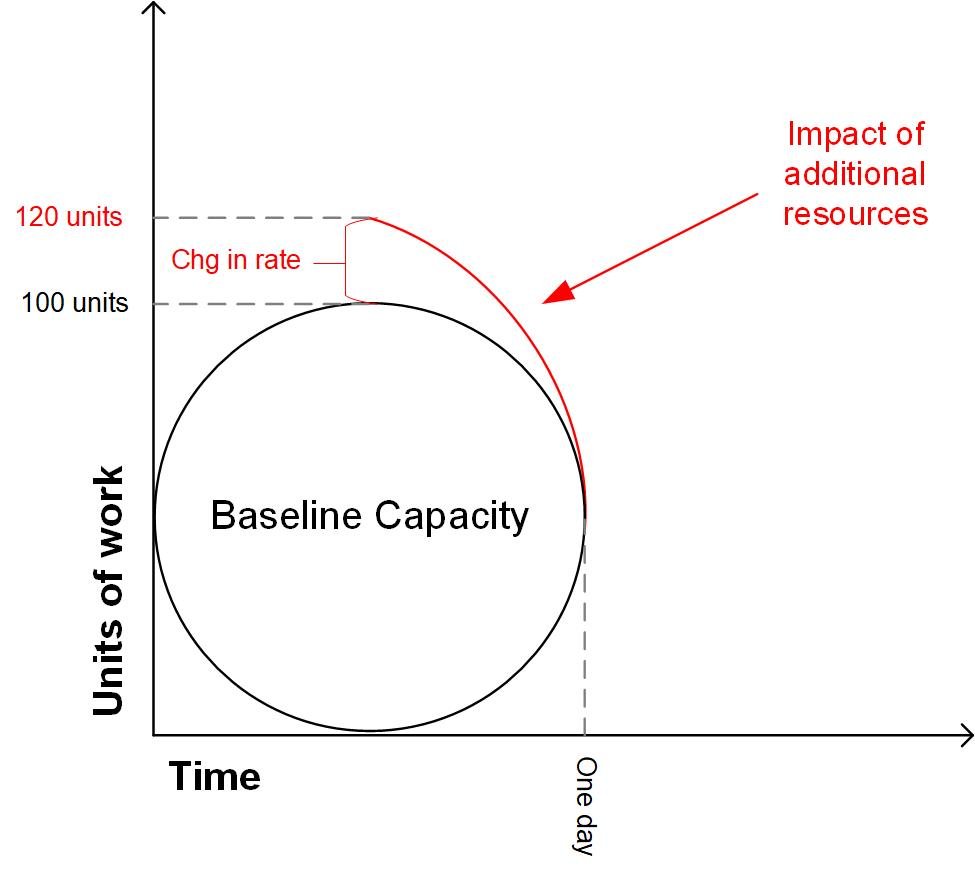
In a simplistic linear example, making a 20% increase in capacity through the addition of new resources or approved overtime for existing resources you might yield a 20% improvement in total productivity within the same time. Unfortunately, the linear example depicted above will be the rare instance. A more likely scenario is measuring the change in team capacity based on the impact of multiple expanding and contracting variables.
A common experience for operations managers from all disciplines is the addition of project work with no expectations in changing productivity levels for the team that will be absorbing the work. In a well-run organization, this should never happen. If the manager has a complete understanding of his or her team’s capacity then there should be a “compression” of the baseline capacity of the team as project work is added on. This compression will result in either a lower production rate in the period or more time to achieve the same production level (or both).
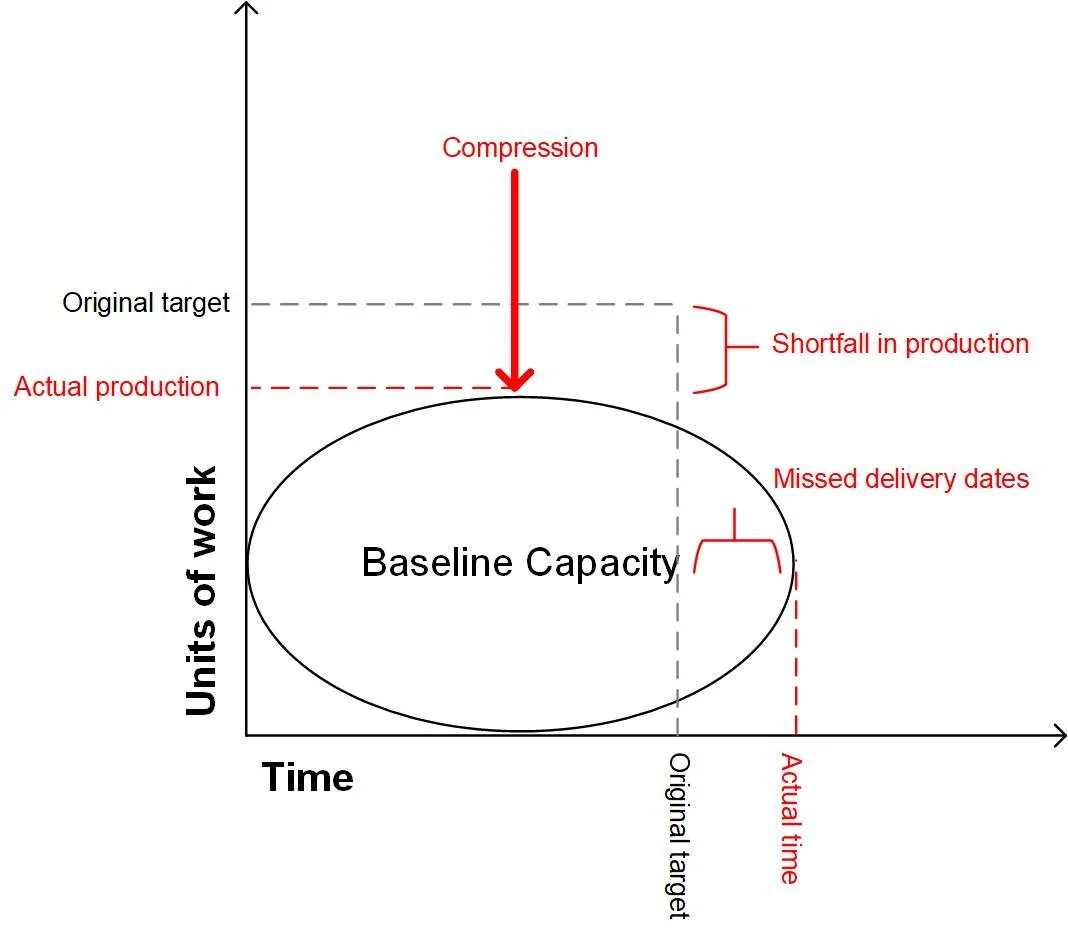
Usually, the first thing that will happen is lower production rates (i.e. producing fewer units of work within the specified time period) or as missed delivery dates. Interestingly, if a team can readily absorb significant project work, then the operations manager has untapped capacity buried deep within his or her organization. It is the absence of a clear understanding of the hidden capacity of a team that drives the need to analyze and measure each unit of work and the variables that could impact it. Without that understanding, it will be very difficult to manage expectations and successfully describe the current state of affairs and/or the impact of changes to the operating environment over time.
With the above said, understanding productivity rates and the impact of contracting and expanding variables is still only a static measure of team capacity. It represents capacity at a single point in time or for a representative period of time, all things remaining equal (i.e. one week).
To get to the next level, operations managers must be able to not only measure current capacity but calculate the team’s overall production “velocity”. It is the combination of defining capacity utilization and changes in production rates over time, or velocity, that will enable predictive models that completely describe the impact of changing operating variables. This is the level of analysis that is required to fully support resource planning on an annual basis, for example. Without that level of understanding the operations manager is making an educated guess regarding future needs based on past performance only.
For more information about this article or our services, reach out to us at info@coeurderoy.com.