
Any businesses with any scale at all will have many traits in common with firms of the same size, regardless of the industry. One of the more unsettling traits is the establishment of operating “siloes”. A silo is defined loosely as a large container of things. In an agricultural sense, siloes will hold grains and other fodder for animals or as storage before going to market. A silo will keep its content safe, but separate. While on the farm that separation is a good thing, while in business it is almost wholly negative.
It is very common for business silos to exist at one or more of three levels. First, there are functional siloes. This is where all people with a particular skillset, such as sales or customer support, all report into the same organization. Next, we have regional siloes, which as the name implies, generally leaves a regional team independent to practice in its own way under the guise of regional client differences. Lastly, we have business units, or business line silos. In larger firms this can make sense, of course. In mid-market firms, this can be an impediment to efficiency.
The thing about functional siloes is that they are not a bad thing per se. Managers, however, often lack the skills or vision to recognize that the input into their silo, the thing that creates a task for his or her team, is the output of a team that is upstream. Similarly, the work that their team produces is often the inputs for the next team down the line.
This is often very clear in a manufacturing business where a procurement team buys raw materials that feed into the manufacturing center that feeds the warehouse that supports sales, etc. But this interconnectivity exists in non-manufacturing businesses as well. In essence, a business is nothing more than a series of interconnected and dependent processes that are linked by their respective inputs and outputs and organized to achieve a specific business outcome.
In this way, the lead generation activities of a Marketing department can never really be separate from Sales. The Sales team and Product teams are linked through the sales strategy. Account Management activities designed to grow an account are linked to performance metrics gleaned from an Analytics team or client temperatures from a Customer Support team. Despite that dependency, people have the tendency to specialize in their careers. This makes it easy for like employees to form into groups that generate self-serving functional measures of success.
This is how many companies become functionally aligned. This alignment has more to do with the depth of skills at the top of the functional organization than it does with achieving a business objective. Teams become groups of specialists with functionally driven metrics and objectives. The solution is to think about teams in terms of business outcomes instead of functional benchmarks, though clearly benchmarks play an important role as well. A Customer Care team might include Account Managers, Support Specialists, Data Analysts and Product Managers working together to achieve a pre-determined and measurable client satisfaction score, for example. At the very least, functional teams can be compelled to work together by establishing goal specific temporary teams to achieve a specific objective, such as managing a new product from inception through rollout to the market.
When functional siloes work together in this way it can make all teams more effective and can lower costs in that oftentimes designated “goal leaders” take the place of extra layers of middle management within a functional silo. These are contributing managers in that they all play functional roles in addition to their role as leaders assigned to drive a cross-functional team to achieve specific business objectives.
Regional siloes tend to be the most dangerous if left unchecked. In many cases a regional silo creates separation in such a manner that a company can suddenly look and feel like it is made up of independent businesses within a business all selling the same kind of product or service. While there are regional differences in how clients operate and perceive the market, there is no solid business reason to run a business in two parts simply because of geographical separation. That may have been true before the advent of virtual conferencing technology and other tools where communication was more difficult, but not in this day and age.
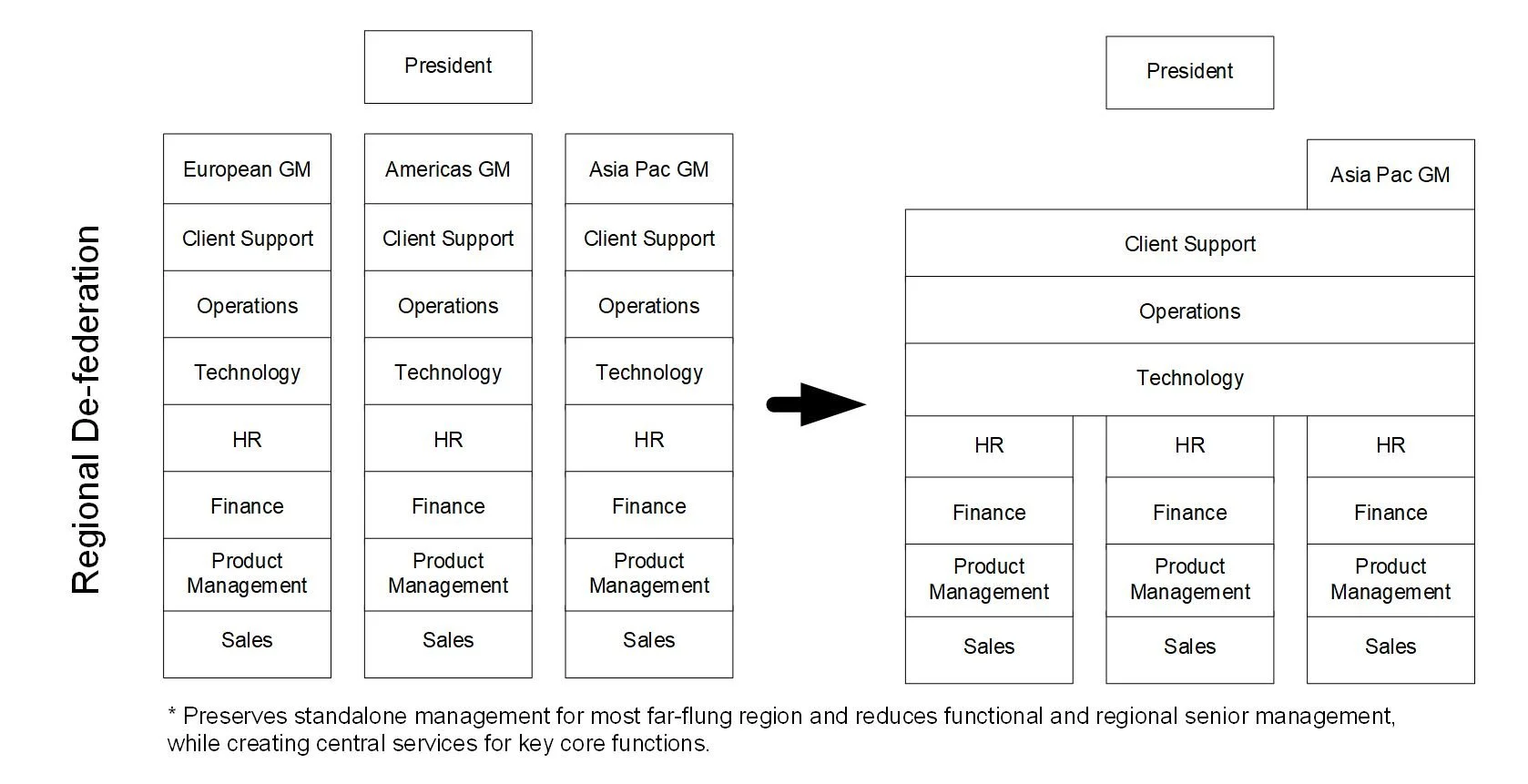
That said, it is super important to have support, product and sales representatives that understand their markets. What is critical is that there is also a global manager who has overall responsibility for each function of the business as well as for the business as a whole. This, when combined with objective-driven functional teams on a global level will force cross-regional collaboration as long as the operating parameters are properly set. Many times, these parameters are set and efforts are controlled by global functional leaders, such as a CTO or Head of Operations, who controls the human and physical assets globally. This can prevent regional managers from operating totally independently because resources, such as engineers, report into a global structure and not a regional structure.
The exception to this rule can be business based in the Americas or Europe with significant operations in Asia, or vice versa. The time differences for these widely distributed groups can make it necessary to provide a bit more independence for one of the global regions. Because of this, it is especially important to have strong global objectives set for businesses as a whole.
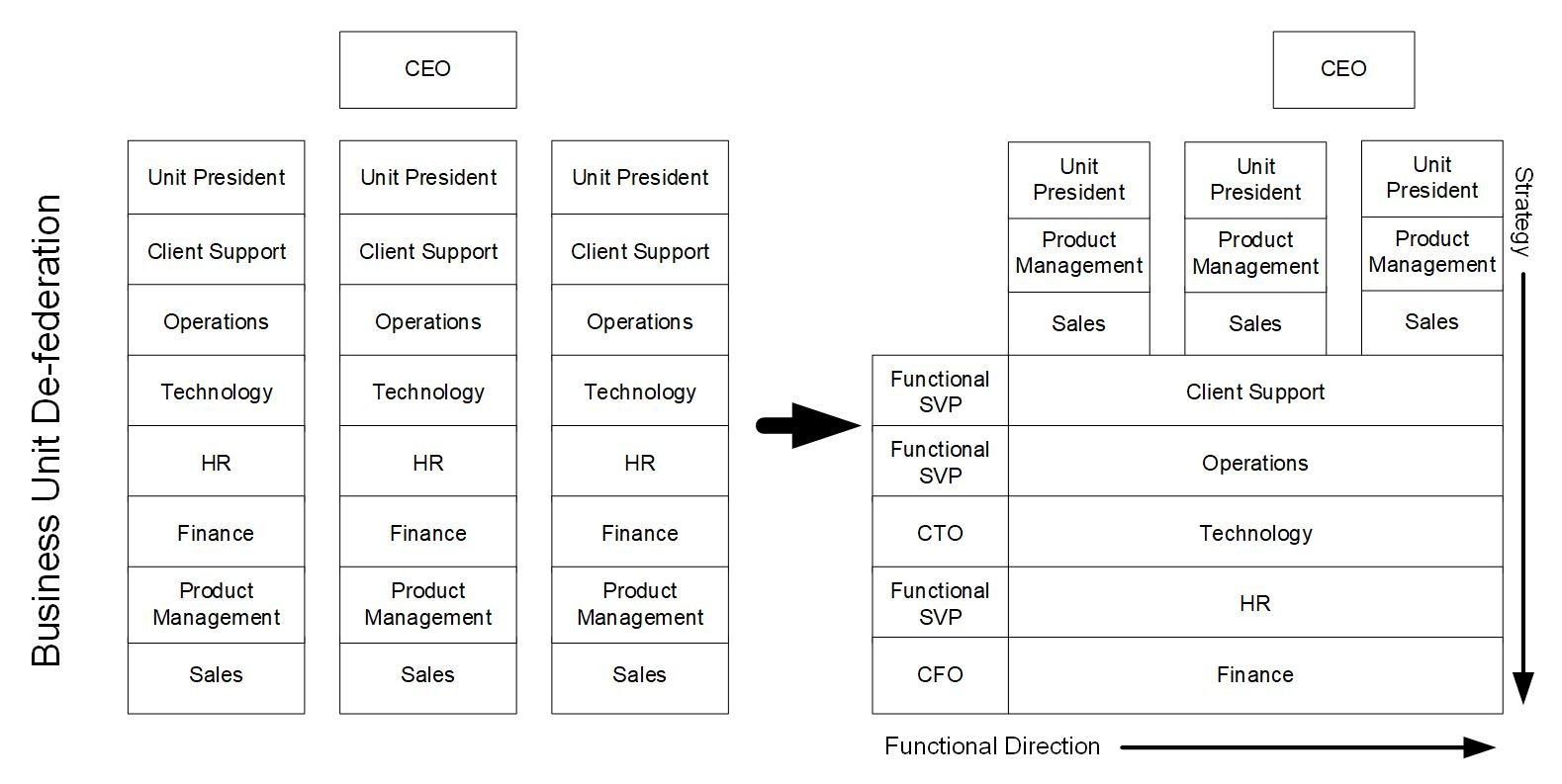
Lastly, business unit silos are operating silos where all functional areas of a business report into a P&L manager who is responsible for the entire business globally. While this can give the P&L leader some amount of control, for the parent company it results in higher carrying costs for the combined business units. This is because each unit will need its own management structure and will often develop its own approach to a common function. These independent approaches naturally result in duplicate tools and processes and an excess of management overhead.
Regardless of the type of silo existing within a business, all businesses with strong operating silos, whether based on region, business line or function, operate in a “federated” manner. In essence, a federated operating environment is one where there are duplicate functions resident in different parts of the business. This can happen partially or on a wholesale level.
The de-federation of a business is a managed process where a business evolves to work more effectively to achieve specified and measurable business objectives. For businesses that are regionally organized, this requires the appointment of global leaders with regional management agents. For businesses with hardcore functional alignments, it means establishing a partial matrix where cross-functional teams are assigned to specific goals within a specific time period to act as one unit. For larger businesses that are aligned by business unit it means establishing global functional leaders to manage core competencies, such as Sales, Engineering or Support, while bolstering Product Management and empowering leaders to focus on the growth of offerings within a market segment.
De-federation will almost always result in a reduction in overhead in the short term as by definition a de-federated team requires fewer senior and mid-level managers to manage operations. Longer term, as the processes utilized by the merged teams begin to come together and teams are cross-trained on different products and regional differences, the business will generally be positioned to achieve economies of scale. These economies of scale can take the form of lower headcount requirements which supports cost reductions or as an offset to future expense growth in a growing firm (i.e. doing more with the same staffing levels).
One of the challenges to a de-federation process is that it is an organizational transformation exercise. Not all managers have the depth of skill or creativity to be successful in that type of environment. Business leadership needs to articulate a clear set of goals and objectives and allow room for the roadmap to develop without putting artificial constraints in place, such as a timeline not based solely on the work to be completed.
This is because to be successful, these organizational shifts will require upskilling existing staff, a net addition of talent, or new tools and will likely encounter many constraints based on the heritage of the team or business’ historical operating models. You de-federate to hit long term strategic objectives, not short-term goals. De-federation can change the business to such an extent that it is generally a one-way street.
For more information about this article or our services, reach out to us at info@coeurderoy.com.