
One of the biggest challenges any manager has to contend with is determining the overall capacity of his or her team. Trying to get more production from your team’s total capacity is like trying to put six gallons of water in a five-gallon bucket. Yet this is exactly what many internal stakeholders ask of their teams. Calculating total capacity is especially challenging when the team is multi-dimensional or widely distributed. Multi-dimensional teams tend to be cross functional or organized by functional silo. In many cases, functional silos are representative of a company’s heritage and not necessarily the most effective structural design. For example, teams may be organized in a way that reflects legacy business units created through acquisition.
Determining the capacity of silos that were conceived from legacy business units can be challenging because each silo will generally have different leadership, have different stakeholders with different priorities and will experience different external pressures. These things will all contribute to an environment where the same type of business practices for similar tasks will evolve differently over time. Oftentimes these tasks will be completed using different processes or tools. Even subtle differences will make it more challenging for managers to build a consolidated view of productivity and achieve economies of scale.
One common scenario where these differences can be relevant is if one production team defines a unit of work at the task level and another defines the unit of work at the whole unit level. This can be complicated further if there are different types or categories of units of work. In these cases, it will be difficult to compare and contrast production velocity across teams in a consistent manner. Not only can this make it difficult to measure productivity, but it can also make it nearly impossible to load balance work across teams. The inability to load balance will result in a higher cost basis than necessary for the function. Generally, you will see this type of scenario develop where there are geographically separated teams or in businesses that have grown through acquisition versus growing organically resulting in different teams doing the same work differently.
For global companies, in addition to needing to deal with teams possessing different operating practices from legacy operating silos, they will almost always also need to contend with a widely distributed team structure. Again, this can be further complicated by time zone differences, regional cultures, HR considerations, etc. This convoluted operating environment can take the form of a single function that is split between several offices or entire functions that exist only in one location but interact with many locations.
Regardless of how these unique operating environments are created, they can complicate stakeholder management greatly. This reflects the fact that stakeholders will oftentimes have a perceived capacity of a team that is quite different than their actual capacity. This makes it critically important to align velocity calculations and reporting in order to manage stakeholder communications. Without good metrics it can be difficult for managers to be fully believable.
A good way to conceptually describe the collective work of a functional team is to think about it as the flow of units of work through a pipeline, where each unit of work is a completed task or group of tasks resulting in a desired outcome. Managers frequently experience difficulties when their stakeholders expect X units of work to be completed by a particular date, and he or she only has capacity to produce Y units of work in that timeframe (where Y is fewer than X). This creates stress because oftentimes the stakeholders are basing other dependent assumptions on the manager’s productivity
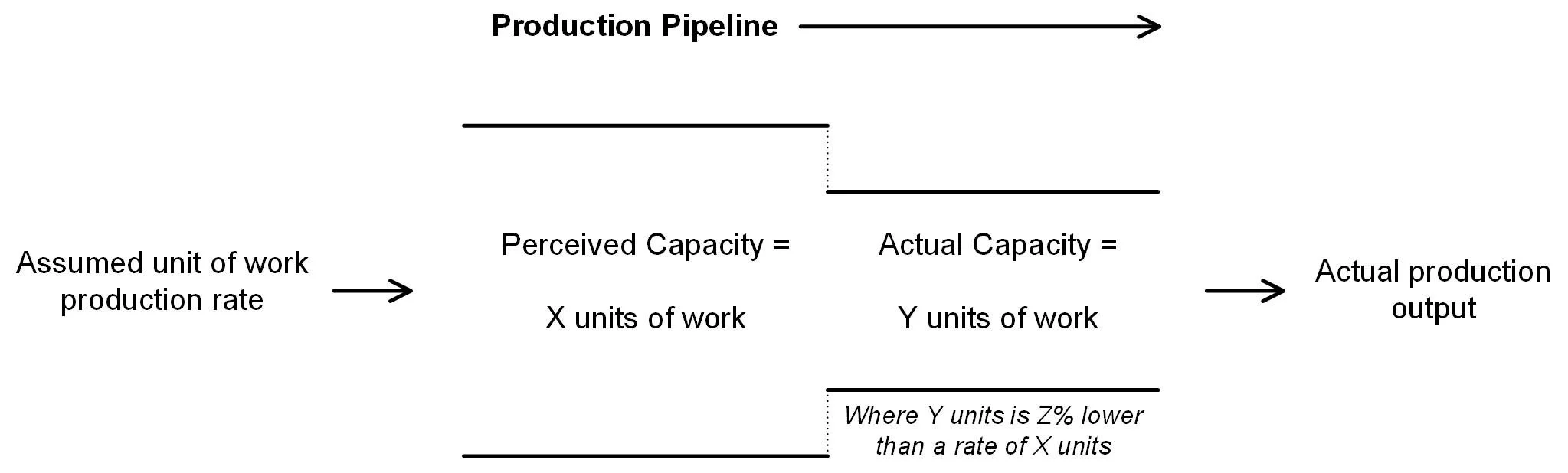
For example, a sales team promises a customer that a deliverable will be ready on a particular date that is 30 days out. Contracts are signed and revenue accrued, etc. That date was selected by assuming that your team would produce Y units of work over the specified timeframe. However, because your team can only produce X units of work (where X is fewer than Y) it is clear that the date will be missed unless some extra effort is achieved by your team.
This scenario is all too common and creates unnecessary stress on all parties. Generally, this scenario is not intentional but rather the sales team in question is basing their assumptions on stale, incomplete (or worse) “wishful” information. As you notify the sales team of your actual production rate, they become immediately concerned that you will miss their dates, and in some cases will escalate their concerns to your management. Your team is stressed because they will potentially need to work overtime or put some other effort aside, thereby creating a different stakeholder issue. Even if you hit the date, the production rates are not sustainable, and you may have dug a hole in other areas that you now need to climb out of. All of this creates an unhealthy operating environment and likely some form of higher costs.
This difference between perceived and actual team capacity generally results in unnecessary pressure being applied to the team members by the stakeholder community as mentioned in the previous example. Sometimes the difference is subtle and can be made up by excess capacity that is built into the team. While on the surface this might seem like a good thing, in reality this ability to overcome shortfalls with unknown extra capacity is at best a sign that the manager does not understand the capabilities of the team fully and at worst the sign of a team generally operating at wildly inefficient rates on a regular basis. That hidden capacity is oftentimes only available in short spurts because the team is accustomed to operating at a particular level that is quite a bit lower. These productivity spurts can yield lower quality results and generally hurt morale.
Much of the difference in perceived and actual capacity levels can be accounted for by stakeholders simply missing variables that the team manager should recognize. This can be as simple as team members’ vacation schedules impacting resource availability or as complicated as the impact of both documented and undocumented efforts by the team when completing their work. Documented efforts are generally sponsored projects where resources have been promised, and deliverables have been defined and socialized. These active efforts may not be widely advertised outside the interested parties and as such they are not factored into stakeholder planning.
Undocumented efforts are represented generally by work that takes place regularly and may be understood by the production resource but, is not part of any run book or process documentation and therefore is not factored into any planning by the uninitiated. The effect is that team members are not actually able to operate at a perceived production level because the units of work, in this case extra tasks, are not defined well and will therefore be underweighted in any analysis.
In order to avoid challenges in managing stakeholder expectations it is important for managers to be able to “size their bucket.” Establishing total capacity is a function of the following: the size and type of each unit of work; the internal (i.e. vacation) and external (i.e. scope creep) variables that could impact production rates; changes in expectations by stakeholders (i.e. faster than normal turnaround time); or the impact of any one-time event or unusual condition.
Being able to establish current “real” capacity will allow managers to establish a benchmark, describe the velocity of any teams’ output and be better positioned to manage the messaging as conditions change.
For more information about this article or our services, reach out to us at info@coeurderoy.com.